




5T Caterpillar Drive Unit
Hangzhou Ocean Industry Co., Ltd. is one of the most experienced manufacturers and suppliers of 5t caterpillar drive unit in China. Welcome to wholesale customized 5t caterpillar drive unit at competitive price from our factory. Good service and quality products are available.
Product Description
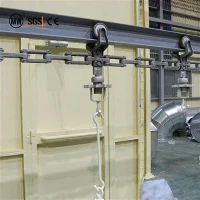
The WT series is a powered overhead conveyor built on the driving-track principle. A speed-regulating motor drives a reducer, the reducer drives the track itself, and the pawls carried on that track push the conveyor chain along. The chain is not pulled from one end; it is propelled at intervals along its length.
That arrangement is why the transmission is described as stable and quiet. Each pawl engages the chain over a short distance and hands it on to the next, so the pull is distributed rather than concentrated, and there is no long unsupported span of chain taking the whole drive torque.
The range covers six models, from WT3 (the X-348 equivalent) up to WT160, and they are dimensioned for different duties rather than being scaled versions of one another. The comparison table on this page sets out the figures that separate them.


How the Drive Works
Motor and reducer. A speed-regulating motor turns through a reducer, which brings the speed down to the range the line needs. Speed regulation matters on an overhead line because the process usually sets the pace: a coating line runs at the speed the oven needs, not at the speed the conveyor would prefer.
The driving track. The output of the reducer goes to the driving track rather than to a sprocket at the end of the circuit. The track carries a series of pawls, and it is those pawls that push the chain.
Why push rather than pull. A chain pulled from one end carries the whole circuit's resistance at that one point. A chain pushed by pawls distributed along the track carries it in shorter steps, which reduces the tension in any one section and lets a long circuit be driven without an unreasonable chain size.
What the arrangement gives up. A pawl drive is a positive drive with some clearance at each engagement, and the art in the design is in the shape and spacing of the pawls. That is why the chain pitch and the hanging spacing in the table are related figures rather than independent ones.
Product Specification
The table below compares the six models across the parameters that decide a conveyor selection, from the load at a single hanging point through to the chain pitch.
|
Conveyor model |
WT3 (X-348)
|
WT4 (X-458)
|
WT6 (X-678)
|
WT80 |
WT100 |
WT160 |
|
Single hanging point load kg |
100 |
200 |
600 |
80 |
500 |
750 |
|
Running speed M/min |
0.5~18 |
0.5~18 |
1~18 |
0.5~15 |
0.5~15 |
0.5~15 |
|
Minimum hanging spacing mm |
306.4 |
409.6 |
612.4 |
320 |
400 |
640 |
|
Allowable tension of chain kg |
900 |
1500 |
2700 |
1100 |
1500 |
3000 |
|
Ultimate load of chain kg |
10900 |
21800 |
38600 |
11000 |
22000 |
40000 |
|
Limit length of conveyor M |
450 |
600 |
750 |
450 |
500 |
700 |
|
Allowable load of slide carriage kg |
1100 |
1800 |
5000 |
1250 |
2500 |
4000 |
|
Ultimate load of slide carriage kg |
1800 |
3600 |
7700 |
2500 |
5000 |
800 |
|
Hardness of roller road surface HRC |
>58 |
>58 |
>58 |
>40 |
>40 |
>40 |
|
Diameter of roller mm |
60 |
82 |
125 |
65 |
100 |
120 |
|
Track type |
工8 |
工10 |
工16 |
工10 |
工12:工14 |
工 8:工16 |
|
Minimum turning radius mm |
R300 |
R450 |
R600 |
R203 |
R317 |
R404 |
|
Minimum vertical radius mm |
R1200 |
R1700 |
R3400 |
R1600 |
R2000 |
R3150 |
|
Chain gauge mm |
64 |
80 |
100 |
75 |
105 |
125 |
|
Chain weight kg |
2.99 |
5.76 |
9.43 |
3.75 |
4.70 |
9.24 |
|
Chain pitch mm |
76.6 |
102.4 |
153.2 |
80 |
100 |
160 |
Reading the Comparison Table
The rows are arranged roughly in the order a selection is made, so it is worth reading them in that order rather than looking for a single decisive figure.
Single hanging point load is what one hanger can carry. Running speed is the range the drive will hold, and minimum hanging spacing is how close two hangers can be. Those three set the throughput a line can deliver. Because they are quoted as ranges rather than as single values, one model can serve more than one duty: the same unit will hold a slow heavy line and a faster lighter one, provided the chain load stays inside its allowable figure in both cases.
On the models that share a pitch family, the middle rows read as a progression: allowable tension, ultimate chain load and limit length all climb together, because a longer conveyor needs a stronger chain for the same load per hanger.
The bottom four rows describe the hardware rather than the performance: roller hardness, roller diameter, track section and the two radii. They matter at the layout stage, because they decide what the line can be built around rather than what it can carry.
Model Range and How to Choose
WT3, WT4 and WT6 are the models identified with the X-348, X-458 and X-678 series. They are the classic light and medium overhead conveyors, and their single hanging point figures run from 100 kg to 600 kg.
WT80, WT100 and WT160 are the heavier family, with 80 kg, 500 kg and 750 kg at a single hanging point and chain pitches of 80, 100 and 160 mm. Note that WT80's hanging point figure is lower than WT3's despite the larger pitch, so the two families are not a simple ladder from light to heavy.
How to choose. Start with the load at one hanger, because that is the figure the trolley and the chain see directly. Then check the limit length against the circuit you have in mind. Then check the two radii against the building, since a model that fits on load can still be impossible to route.
Application
The range is used where product has to travel overhead rather than along the floor, and the duties below are the ones it is normally specified for.
Logistics and warehousing. Heavy goods move above the storage and the pick faces, so the conveyor does not take up aisle space that the racking needs.
Sorting systems. Overhead circuits feed sorters from above, which suits buildings where the floor is already committed.
Painting and coating lines. The hanger holds the workpiece in a fixed attitude through spray, flash-off and the oven, which is what keeps coating thickness even.
Suspension conveying inside factories. Aerial lines link stations across a shop floor without cutting across it at ground level.
Airport baggage. Overhead transport of baggage between check-in, sortation and make-up areas.
Construction sites. Transport of materials where a floor-mounted conveyor would be in the way of the work.
Performance Characteristics
Carrying capacity. The series is offered as a heavy-duty conveyor, and the table is the honest statement of what that means: the largest single hanging point figure in the range is 750 kg, while the chain's allowable tension reaches 3000 kg and the carriage figures run higher again. Those are different numbers measuring different things, and the selection has to respect the smallest of them for the duty in question.
Stable running. Because the chain is guided in a track and pushed by pawls along its length, the load does not hang from a single drive point. Vibration and swing are controlled at the trolley and the guide rather than by tensioning the chain harder.
Even power transmission. The pawls hand the chain on from one to the next, so the power goes in at intervals along the circuit instead of all at one end.
Adapting to the building. The two radii in the table are what allow a circuit to be routed around columns, over walkways and through process equipment rather than being confined to a straight run.
Structural Design
The structure. The main supporting structure is fabricated from high-strength steel, and the sections are chosen so that the track stays in alignment under a moving load rather than deflecting between supports.
The layout. Track, drive and trolleys are arranged so that the circuit can be installed on an existing line without a large footprint, and so that the parts that need attention are reachable from a walkway.
The running surface. The chain runs on rollers, and the roller road surface is hardened: above 58 HRC on the WT3, WT4 and WT6 models and above 40 HRC on WT80, WT100 and WT160. That is the surface that decides how long the track lasts under a given load, which is why it is a table row rather than a footnote.
The track section. The track type column gives the section each model runs in, and the sections are the standard rolled channel sizes. Track and model have to be matched: the section carries the roller, and a model specified against the wrong section will not run true.
Track, Trolley and Running Surface
Three components do the physical work: the track, the chain and the trolley. Understanding which one is loaded in which direction explains most of the maintenance behaviour of an overhead conveyor.
The track carries the vertical load and holds the line. It is loaded in bending between its supports and in wear at the roller road, and both are fixed by the section chosen and by the hardness of that road.
The chain provides the movement and takes the pull. Its allowable tension and its ultimate load are the two figures in the table that describe it, and the ratio between them is the margin the design works within.
The trolley carries the product and takes the load at the hanging point. Its allowable and ultimate figures are given separately again, because a trolley can be overloaded while the chain is perfectly comfortable.
Reading the table with that division in mind is what stops a conveyor being selected on one figure when three are actually limiting.
Load Path: Hanging Point, Chain and Carriage
A load placed on a hanger passes through three stages before it reaches the structure, and each stage has its own limit.
At the hanger. The single hanging point figure is the load one hanger is rated for. It is the figure the operator sees and the one most easily exceeded, because it is the load a person actually hangs. It is also the figure that should be posted at the loading station, since an operator has no way of judging the chain tension or the carriage rating from the product in front of them.
Into the trolley. The trolley's allowable load is the figure for the carriage assembly, and it is usually higher than the hanging point figure because one trolley may serve several hangers.
Into the chain. The chain sees the sum of the loads on the circuit, shared according to where the drive is pushing. The allowable tension is the working figure and the ultimate load is the failure figure; the gap between them is the fatigue margin, and a conveyor designed close to the allowable tension will run, but not for as long as one designed inside it.
The practical rule is that the smallest of the three governs. A line can be inside its chain rating and outside its hanger rating, or the reverse, and the weaker one decides.
Speed, Spacing and Throughput
Throughput on an overhead conveyor is set by three numbers working together, and the table gives all three for every model.
Speed is the running speed range the drive will hold. Hanging spacing is the closest two hangers can be, which is fixed by the pitch and the trolley geometry rather than by preference. Throughput is what you get when you divide the speed by the spacing and allow for the parts per hanger.
The consequence is that raising the speed is rarely the cheapest way to raise throughput. Halving the spacing doubles the number of hangers passing a point, but it also doubles the number of trolleys on the circuit and changes the load the chain carries. On a line that is already near its allowable tension, closing up the spacing is the wrong direction.
The useful calculation at the design stage is the other way round: fix the throughput the process needs, work back to the spacing the process can tolerate, and then check that the resulting chain load is inside the allowable figure for the model.
Curves, Inclines and the Two Radii
The two radius rows are the ones that decide whether a layout can be built at all, and they are frequently the reason a model is rejected after it has passed on load.
Minimum turning radius is the tightest horizontal curve the chain will follow. It opens up as the models get larger: R300 on the WT3 against R404 on the WT160. A building with a tight corner can therefore rule out the heavier model regardless of what it has to carry.
Minimum vertical radius is the tightest rise or fall. This is the figure that most often catches people out, because a vertical transition looks harmless on plan and is expensive to widen later.
Why the radii grow with size. A larger chain has a longer pitch and a deeper link, and both of those set how tightly it can articulate before the links bind against each other. The radius figures are a property of the chain, not a layout preference.
Where a layout is inside a radius with very little to spare, the practical fix is normally to widen the radius instead of moving to another model, since a different model brings a different track and different trolleys with it.
Installation and Commissioning
Set the track before the chain. The track is installed and aligned against the layout first, because everything else references it. Alignment is checked along the run and through the curves, not only at the supports.
Fit the drive and check the engagement. The driving track and its pawls are then set so that they engage the chain squarely. A pawl that meets the chain at an angle wears both, and the symptom is a noise that appears once per pitch.
Thread the chain. The chain is run into the track and joined, then the tension is set to keep it seated without pulling it tight. An overhead chain needs enough tension to stay in the track at the drive and the curves, and no more.
Run it empty first. A no-load run at low speed confirms that nothing binds and that the drive is engaging cleanly before any product is committed to the line. Only then is the speed brought up to the process figure. On a line that runs continuously the empty run is also the moment to listen: a single knock per pitch is a pawl meeting the chain at an angle, while a continuous rub is a track alignment problem, and the two are corrected in different places.
Maintenance and Inspection
What wears. On this type of conveyor the wearing items are the roller road surface, the chain joints and the trolley wheels. The hardened road is what keeps the first of those slow, which is why the hardness figures are quoted in the table.
What to check, and how often. A fixed interval beats an inspection triggered by a fault. At each interval: chain tension and take-up travel remaining, the condition of the roller road, the trolley wheels, and the engagement of the pawls. A chain that has started to run noisily at one point in the circuit is usually telling you about a track defect rather than about itself.
Lubrication. The chain joints and the trolley bearings are the lubricated points. On a painting line the lubricant has to be one that will not contaminate the process, which is a selection question worth settling before the line is commissioned rather than after.
Records. A simple log of tension, take-up travel and the date of each inspection is what turns a maintenance routine into something that predicts a replacement rather than reacting to a failure.
Quality Control and Test Records
At the components. Track sections, chain and trolleys are checked against the specification before assembly: the track for straightness and section, the chain for pitch, and the trolleys for wheel fit and freedom.
At the drive. The reducer and the driving track are checked together, since the engagement between the pawls and the chain is what the drive depends on. That is the assembly most worth testing before dispatch.
At the completed unit. Where a conveyor is supplied as a line rather than as components, it is run before dispatch and the running figures are recorded.
Documentation. Records are held against the order, so a component in service can be identified from the order it came from. Where the end customer requires test or inspection documents with the consignment, it is worth raising at the order stage, because the records are compiled while the order is being built.
Packing, Marking and Dispatch
Packing. Track sections are bundled by length and protected at the ends, chain is coiled or crated, and the drive is packed separately because it is the item that suffers most in transit.
Marking. Each bundle and crate is marked with the order number, the model and the item, so that a multi-item consignment can be sorted on site without opening everything.
Loading. Steel track is dense and long, so loading is planned by both weight and length. The arrangement goes out with the shipping documents rather than being left to the loader.
Dispatch. Before the container is closed, the packing list and the loading photographs are issued, which means a shortage is identified at the works instead of after arrival.
Why Buyers Choose This Conveyor
It is a positive drive that does not need a heavy chain. Distributing the push along the track is what allows a long circuit to be driven without moving up a chain size.
The range is wide enough to fit the duty rather than the other way round. Six models from 80 kg to 750 kg at a hanging point, with chain pitches from 76.6 mm to 160 mm, cover most overhead duties without a bespoke design.
The figures are published. Load, speed, spacing, tension, radii and roller hardness are all in the table, which means a layout can be checked against the conveyor before anything is ordered.
It runs above the floor. The space underneath stays available, which on a crowded site is often the reason an overhead line is chosen in the first place.


FAQ
Q: Do you manufacture the conveyors yourselves?
A: A manufacturer. The conveyor and its components are produced at our own works, which is what allows a non-standard track length or a bespoke hanger to be quoted alongside a standard model.
Q: How long is the delivery time?
A: A sample or trial item normally takes around 15 working days. A production order takes 30 to 60 working days from receipt of the deposit, depending on the models and the quantities.
Q: What payment terms do you offer?
A: T/T, 30% as deposit with the balance of 70% before delivery. Photographs of the products and the packing are sent before the balance is paid.
Q: Which model should I choose?
A: Start with the load at a single hanging point, then check the limit length against your circuit, then check the two radii against the building. The smallest of those three results is what decides the model.
Q: What does the WT3 (X-348) figure in brackets mean?
A: It identifies the model with the established X-348 series of overhead conveyors, so a buyer replacing or extending an existing line can match it directly. WT4 and WT6 correspond to X-458 and X-678 in the same way.
Q: What is the maximum load one hanger can carry?
A: The largest figure in the range is 750 kg on the WT160, and the smallest is 80 kg on the WT80. That is the figure for a single hanging point, not for the chain or the carriage, which have their own higher limits.
Q: Why is WT80 rated lower than WT3 at the hanging point?
A: They belong to different families. WT3, WT4 and WT6 follow the X-series geometry, while WT80, WT100 and WT160 are the heavier family built on larger pitches, so the two are not a simple ladder and the figures should be compared within a family first.
Q: What track does each model run in?
A: The track type row gives the section for each model, in the standard rolled channel sizes. The model and the track section have to be matched; the table states which section each one runs in.
Q: How tight a curve can the conveyor take?
A: It depends on the model. The minimum turning radius runs from R300 on the WT3 to R404 on the WT160, and the minimum vertical radius from R1200 to R3400. Both figures grow with the chain size.
Q: Can the conveyor be routed through an oven or a paint line?
A: Yes. Routing through a process is one of the main reasons for choosing an overhead conveyor, and the hanger holds the workpiece in a fixed attitude through spray, flash-off and curing.
Q: How is the chain driven, and does it need a tensioner?
A: A speed-regulating motor drives a reducer which drives the track, and pawls on the track push the chain. Tension is still set so the chain stays seated in the track through the drive and the curves, but the drive does not depend on tension to transmit power.
Q: What needs maintaining, and how often?
A: The roller road, the chain joints, the tension and take-up travel, and the trolley wheels. A fixed inspection interval is better than an inspection triggered by a fault, particularly on a line that runs continuously.
Q: Is a custom length or a bespoke hanger possible?
A: Yes. Track can be supplied in the lengths the layout needs, and hangers can be made to suit the product. Send the layout together with the product details, and the arrangement can be confirmed before anything is placed.
Q: What information do you need to quote a conveyor?
A: The circuit layout, the load at each hanger, the throughput the process needs, the tightest curve and incline in the building, and whether the line is new or an extension of an existing one.
Hot Tags: 5t caterpillar drive unit, China 5t caterpillar drive unit manufacturers, suppliers, factory, stepper drive unit, Linear Drive Unit, 5T Oxback Type Drive Unit, Five Tons Series Drive Unit, motor drive unit, quality drive unit
Previous
5T Oxback Type Drive UnitYou Might Also Like


Send Inquiry