


QXG200 Take-Up Tension Unit
Hangzhou Ocean Industry Co., Ltd. is one of the most experienced manufacturers and suppliers of qxg200 take-up tension unit in China. Welcome to wholesale customized qxg200 take-up tension unit at competitive price from our factory. Good service and quality products are available.
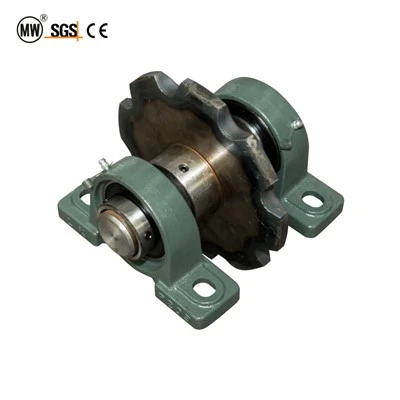
QXG200 Take-Up Tension Unit & Tail Wheel Assembly – Light-Duty Driven Return End for 200 mm Pitch Overhead Conveyor Chains
Every closed-loop overhead conveyor system depends on two anchor points: a powered drive sprocket at the forward end that propels the chain loop, and a driven return assembly at the far end that redirects the chain back toward the drive while maintaining precise operational tension. The QXG200 take-up tension unit / tail wheel assembly serves as that second anchor - a purpose-built driven return end engineered specifically for 200 mm pitch QXG-class enclosed-track overhead conveyor chains deployed in painting, powder-coating, electroplating, and continuous finishing lines.
Unlike generic idler pulleys adapted from belt-conveyor applications, the QXG200 tail wheel assembly is configured around a toothed return sprocket whose profile matches the 200 mm chain pitch exactly. This pitch-matched engagement eliminates the chain–sprocket meshing errors that generic return wheels introduce - errors that manifest as rhythmic vibration, accelerated link-pin wear, and audible chain slap at speeds above 5 m/min. The integrated tensioning mechanism (available in spring-loaded and gravity-weight configurations) continuously compensates for chain elongation accumulated through thermal cycling (–20 °C to 200 °C), wear-induced pitch growth, and load-dependent stretch across the conveyor circuit.
As a driven return end component rather than an active drive unit, the QXG200 take-up assembly absorbs no motor torque and requires no electrical connection. Its sole mechanical responsibilities are: (1) provide a smooth, low-friction chain direction reversal; (2) maintain a calibrated back-tension in the return leg of the chain loop; and (3) allow maintenance personnel to adjust, measure, and lock chain tension from a single access point at the line's far end. The unit is supplied as a bolt-together assembly compatible with the standard QXG200 72 × 68 × 4 mm enclosed I-beam track profile.
Why the Take-Up / Tail Wheel Assembly Matters
In a QXG overhead conveyor circuit, the chain forms a continuous loop: drive sprocket → process path (booths, ovens) → driven tail wheel → return leg → back to drive sprocket. The driven tail wheel serves three interconnected functions that directly affect chain service life, operational noise, and paint-finish quality:
Chain direction reversal. At the conveyor's far end, the tail wheel sprocket receives the chain loop from the process path and redirects it into the return leg. The toothed sprocket profile ensures each 200 mm pitch link engages cleanly without impact-loading at tooth-tip contact - provided the sprocket is correctly matched to the chain pitch.
Back-tension regulation. Without active tension control, a slack return leg allows the chain to whip, vibrate, and potentially skip teeth at the drive sprocket - producing uneven line speed, paint-thickness variation, and premature sprocket wear. The integrated tension mechanism maintains a calibrated pre-load in the return leg, absorbing chain elongation as it accumulates.
Wear-compensation reservoir. Chain links elongate over thousands of operating hours as pin-bushing interfaces abrade. The take-up's adjustment range provides the stroke capacity to absorb this growth before the chain must be shortened or replaced - typically 3–5% of total loop length before re-tensioning is exhausted.
Tension Mechanism Types & Selection
The QXG200 take-up unit is offered with two distinct tensioning architectures. Selection depends on conveyor line length, temperature fluctuation severity, and desired level of hands-off automation:
Spring-Loaded Tension (S-Type)
A helical compression spring assembly pushes the tail wheel sprocket mounting plate outward against the chain loop, maintaining a pre-set back-tension. Spring pre-load is adjustable via a threaded tension bolt accessible from the outer face of the unit housing.
|
Attribute |
Spring-Loaded Tension |
|
Tension source |
Helical compression spring (pre-calibrated spring constant) |
|
Adjustment method |
Threaded tension bolt with lock nut |
|
Auto-compensation |
Partial - spring automatically absorbs minor elongation within its travel stroke; manual re-adjustment required when stroke is exhausted |
|
Best for |
Shorter lines (≤150 m loop); stable ambient temperatures; limited height clearance where gravity weights interfere |
|
Temperature sensitivity |
Spring constant varies ~5% across –20 to 200 °C range; acceptable for most indoor applications |
|
Installation orientation |
Horizontal or vertical mounting; not dependent on gravity for tension generation |
|
Maintenance requirement |
Monthly visual inspection of spring pre-load; annual spring-endurance check on high-cycle lines |
Gravity-Weight Tension (H-Type / Hammer Type)
A counterweight stack (adjustable by adding or removing weight plates) applies a constant downward force to the tail wheel mounting carriage via a lever arm or direct-suspension linkage. Chain tension remains invariant across the full temperature range because gravitational pull is independent of thermal state.
|
Attribute |
Gravity-Weight / Hammer Tension |
|
Tension source |
Adjustable counterweight stack (cast iron or steel weight plates) |
|
Adjustment method |
Add or remove individual weight plates (typical increment: 2.5–5 kg per plate) |
|
Auto-compensation |
Full - gravity provides constant tension across the entire mechanical wear stroke; no spring relaxation over time |
|
Best for |
Longer lines (≥150 m); temperature-cycling ovens and paint curing zones; installations where consistent line tension is critical to finish quality |
|
Temperature immunity |
Tension fundamentally independent of temperature; weight-based force does not weaken with heat |
|
Installation orientation |
Vertical suspension required (gravity-dependent); allocate approximately 500–800 mm vertical clearance below track |
|
Maintenance requirement |
Bi-annual inspection of weight-plate stack integrity and suspension linkage; verify free vertical movement |
Technical Specifications
The QXG200 take-up tension unit / tail wheel assembly is engineered to interface with the standard 200 mm pitch enclosed-track overhead conveyor chain running within a 72 × 68 × 4 mm I-beam track profile.
|
Parameter |
QXG200 Take-Up (Spring Type) |
QXG200 Take-Up (Hammer/Weight Type) |
|
Compatible Chain Pitch |
200 mm |
200 mm |
|
Compatible Track Profile |
72 × 68 × 4 mm enclosed I-beam |
72 × 68 × 4 mm enclosed I-beam |
|
Sprocket Tooth Count |
8T (standard); 10T (optional) |
8T (standard); 10T (optional) |
|
Sprocket PCD |
~520 mm (8T); ~650 mm (10T) |
~520 mm (8T); ~650 mm (10T) |
|
Sprocket Bearing Type |
Double-sealed deep-groove ball bearing |
Double-sealed deep-groove ball bearing |
|
Sprocket Material |
45# carbon steel, induction-hardened tooth profile |
45# carbon steel, induction-hardened tooth profile |
|
Frame / Housing Material |
Welded Q235 structural steel plate |
Welded Q235 structural steel plate |
|
Tension Stroke (adjustment range) |
80–120 mm |
150–250 mm |
|
Tension Force (adjustable) |
100–500 N (via spring pre-load thread) |
50–500 N (via weight-plate stack) |
|
Max. Chain Tension at Return End |
3.0 kN (matches QXG200 allowable tensile force) |
3.0 kN |
|
Operating Temperature |
–20 °C to +200 °C |
–20 °C to +200 °C |
|
Surface Treatment |
Epoxy e-coating (black); optional hot-dip galvanizing |
Epoxy e-coating (black); optional hot-dip galvanizing |
|
Mounting Orientation |
Horizontal or vertical (spring type is orientation-independent) |
Vertical suspension required (gravity-dependent) |
|
Unit Weight (approx.) |
12–15 kg (excluding chain) |
18–25 kg (excluding chain and weights) |
|
Lubrication |
Factory-sealed bearings (lifetime-lubricated); sprocket teeth: dry |
Factory-sealed bearings (lifetime-lubricated); sprocket teeth: dry |
Note: The take-up unit is shipped as a pre-assembled bolt-together kit including the tail wheel sprocket, bearing housing, tension mechanism (spring or weight linkage), track-mounting brackets, and M12/M16 anchor bolts for floor or overhead structural attachment. Chain is not included; order separately as QXG200 drive chain by the metre.
Installation, Alignment & Initial Tension Calibration
Proper installation of the QXG200 take-up / tail wheel assembly is critical to achieving quiet operation (<62 dB) and extending chain service life beyond 10 000 operating hours. The following six-step protocol should be followed during initial commissioning:
Position selection. Install the take-up unit at the point of lowest chain tension in the conveyor circuit - typically immediately after the last process station (after the cool-down zone exit) and before the chain begins its return leg. Positioning downstream of heavy-load decline sections produces insufficient tension and accelerates chain whip.
Sprocket-to-track centreline alignment. The tail wheel sprocket's tooth centreline must lie exactly in the vertical plane of the enclosed I-beam track slot. Lateral offset exceeding 1 mm forces the chain to enter the sprocket at an angle, generating uneven tooth loading and accelerated flank wear. Verify alignment with a laser or plumb line before bolting the unit mounting plate.
Sprocket rotational alignment. Rotate the sprocket by hand through one full revolution before chain insertion. It should spin freely with no binding, grinding, or intermittent resistance. Any mechanical roughness indicates bearing contamination, housing misalignment, or shipping damage - resolve before proceeding.
Initial tension set-point. Set initial back-tension to 3–5% of the chain's allowable tensile force: 90–150 N for standard QXG200 chain (3.0 kN rating). For spring-type units, wind the threaded tension bolt until the spring compression indicator reaches the pre-calibrated mark. For gravity-weight types, start with 2–3 weight plates and add incrementally until chain sag in the longest unsupported return-leg span is eliminated.
Empty-run monitoring. Run the conveyor empty for 30–60 minutes while observing tail wheel sprocket engagement. Listen for rhythmic clicking (indicates tooth interference from a pitch mismatch or alignment error) and watch for lateral chain oscillation at the sprocket entry point (indicates insufficient tension). Correct any irregularity before loading workpieces.
Lock and document. Once the correct tension is achieved, tighten all lock nuts and document the set-point (spring compression position or weight-plate count) in the line's maintenance log. This baseline enables rapid diagnosis if tension-related problems appear later in the equipment life cycle.
Typical Deployment Scenarios
Automotive Component Painting & E-Coat Lines
Vehicle sub-assembly painting lines (door panels, bumper fascias, mirror housings) where consistent 3–8 m/min line speed through spray booths and 180 °C curing ovens is essential. The hammer-type QXG200 take-up unit's gravity-based tension maintains constant back-force regardless of oven-induced thermal chain expansion, preventing the speed drift that spring-type units can exhibit during daily heat cycling.Powder-Coating Conveyor Systems for Medium-Sized Workpieces
Enclosed-track powder-coating lines handling furniture frames, shelving brackets, and appliance panels at 5–12 m/min benefit from the spring-type take-up's compact footprint. The unit mounts flush at track end without occupying floor space beneath the conveyor, leaving that area free for powder-recovery hoppers and manual touch-up stations.
Electroplating & Wet-Process Finishing Lines
Zinc, nickel, and chrome plating lines where the chain repeatedly enters and exits chemical baths require a take-up unit whose bearings are fully sealed against acidic vapour and rinse-water mist. Both QXG200 tension configurations use double-sealed bearing housings; the hammer-type variant is preferred here for its temperature-independent tension constancy during hot-rinse and drying stages.
Appliance & White-Goods Assembly Overhead Conveyors
Refrigerator, washing machine, and air-conditioner assembly lines with 30 kg per-point workpieces - matching the QXG200 chain's rated load ceiling - rely on the tail wheel assembly to maintain smooth chain direction reversal at the return end without introducing vibration that could disturb partially assembled components during transit.
FAQ

Hot Tags: qxg200 take-up tension unit, China qxg200 take-up tension unit manufacturers, suppliers, factory, 5T Caterpillar Drive Unit, Angular Drive Unit, dc drive unit, Heavy Duty Drive Unit, motor drive unit, quality drive unit
You Might Also Like




Send Inquiry