


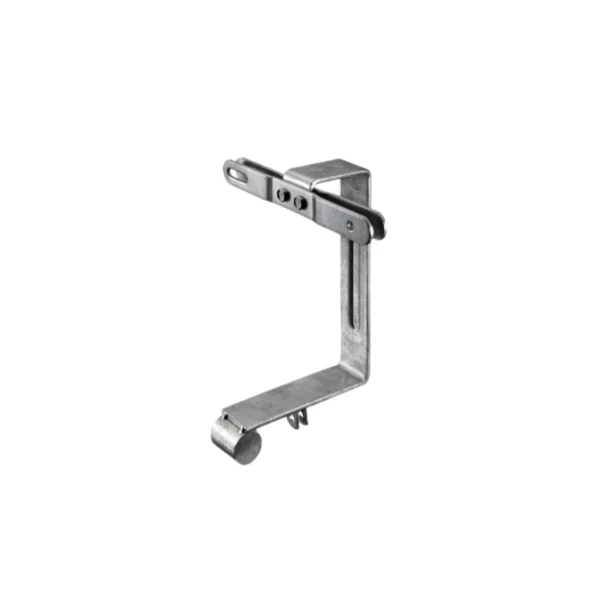



C Shaped Spreader
Hangzhou Ocean Industry C-Shaped Spreader is specifically designed to optimize throughput in complex overhead conveyor networks. Leveraging decades of Hangzhou manufacturing expertise, we offer a robust lifting device that balances payload stability with ease of access.
Why Industry Leaders Choose Our C-Shaped Design:
Zero-Sway Transportation: The ergonomic C-configuration ensures the vertical load line aligns with the conveyor trolley, minimizing pendulum effects.
Rapid Cycle Loading: The unobstructed side access enables seamless integration with robotic loading arms or manual pick-and-place stations.
Space-Saving Geometry: Its compact engineering allows for tighter rail configurations, maximizing your facility's cubic storage and transit capacity.
Multi-Sector Reliability: From heavy automotive castings to delicate distribution containers, our hangers are tested for 2x rated load safety.

| Model | Load Capacity | Compatible Beam Width | Material | Surface Treatment | Safety Factor |
|---|---|---|---|---|---|
| CS-300 | 150-300 kg | 100-150 mm | Q235B Steel | Hot-dip Galvanized | 5:1 |
| CS-800 | 300-800 kg | 150-250 mm | Q235B Steel | Hot-dip Galvanized | 5:1 |
| CS-1500 | 800-1,500 kg | 200-300 mm | Q345B Steel | Powder Coated | 4:1 |
| CS-3000 | 1,500-3,000 kg | 250-400 mm | Q345B Steel | Powder Coated | 4:1 |
| CS-5000 | 3,000-5,000 kg | Custom Sizes | Alloy Steel | Custom Finish | 4:1 |
Standard Features:
Precision-machined load-bearing surfaces
Reinforced weld points with NDT testing
Adjustable trolley mounting points
Safety latch mechanisms (optional)
Identification tags and load rating plates
Structural Features
The C shaped structure, made of high - strength alloy steel with ingenious design, reduces dead weight while ensuring strength, making the spreader more flexible during operation. The open C shaped is convenient for loading and unloading goods and better adapts to items of different shapes and sizes, improving operation convenience. For the light closed - track system, key components like the spreader's walking wheels are precisely designed. Made of high - quality wear - resistant materials, they have good guidance and low friction, running smoothly on the track to reduce noise and wear. The compact connection between the spreader and the track prevents derailment and other safety hazards.
Material characteristics
Its main structure often employs high-strength alloy steel. This material choice is due to considerations of strength and load-bearing capacity. High-strength alloy steel offers outstanding load-bearing capacity for the spreader. This material can endure enormous tensile and compressive forces, ensuring that the spreader will not deform or be damaged when lifting and moving heavy loads. This is of utmost importance for maintaining the structural stability of the spreader. In practical operations, the spreader must reliably carry the weight of the cargo to prevent any potential safety hazards.
Working Principle
Its lifting mechanism is powered by an electric motor. Transmitted through a reducer to the wire rope drum for power conversion, the hook can be raised or lowered to handle goods. The lifting speed can be controlled by adjusting the motor's rotational speed. The spreader moves on the light - duty track via walking wheels. The driving system powers the wheels to rotate and generate thrust, and the precise design of the track and wheels ensures accurate movement.
Advantages
①Powerful lifting capacity: The C-type spreader can carry heavy loads. Whether it is large parts in mechanical manufacturing or some medium-sized structural materials in the construction industry, it can reliably complete the lifting task and effectively meet the weight requirements in production operations.
②Excellent adaptability: It fits well with the light-duty track. Specifically designed for the light-duty track, the walking mechanism and connection parts of the spreader are perfectly matched with the track specifications. When the walking wheels run on the track, they fit closely and smoothly without any jamming or shaking phenomena, ensuring stable operation of the spreader on the track.
③Adaptation to various track layouts: This spreader can adapt to different forms of light-duty track layouts. Whether it is a straight track or a curved track, it can operate flexibly. In complex industrial plants or logistics warehouses and other environments, it can effectively handle lifting tasks with various track orientations.
⑤Efficient operation: Its operation process is relatively simple and can quickly complete the loading, lifting, and unloading processes of goods. This reduces the time for each lifting operation and improves the overall work efficiency, helping to enhance the production and logistics efficiency of enterprises.
⑥Good stability: The structural design of the C-type spreader is scientific and reasonable. It is made of high-strength materials and is structurally stable during the lifting process and will not be easily deformed.
Application
Steel mill: In the steel production process, there are a large number of steel coils that need to be transported and stored. The C-type spreader can lift steel coils of various specifications safely and efficiently.
Machinery processing factory: It is used to lift large mechanical parts such as large gears, transmission shafts, and machine tool beds. It is convenient for operations such as transportation, installation, or debugging in the workshop.
Automobile manufacturing plant: On the automobile production line, some large body structural parts, engine assemblies and other components need to be transferred between different workstations during the production process. The C-type spreader can be customized according to the shape and weight of the components to ensure the safety and efficiency of the lifting process and improve production efficiency.
Warehousing and logistics field: In large warehouses, the storage and transportation of goods are important contents of daily work. The C-type spreader can be used to lift various goods such as bundled steel, wood, plastic pipes, etc.
Center of Gravity Balance Design for C Shaped Spreaders
Unlike fixed spreaders, the C-shaped design requires correct positioning of the workpiece's center of gravity (CoG) relative to the spreader's vertical axis. Misalignment causes tilting, swing, and in severe cases, derailment from the overhead track. Follow these guidelines:
Step 1 - Locate the Workpiece CoG For symmetrical parts (engine blocks, gearboxes, motor casings), the CoG is at the geometric center. Mark this point before lifting. For irregular parts (crankcases, hydraulic valve bodies), the CoG is offset - use a two-point lift test or a CoG calculation sheet (available from our engineering team).
Step 2 - Match CoG to the C-Shape Apex The C-shape apex (the point where the two arms meet at the bottom) should be directly above the CoG. The vertical offset between the apex and the CoG must not exceed 50 mm for parts under 500 kg, or 30 mm for parts over 500 kg. If the offset is greater, specify an asymmetric C-shaped spreader with one arm longer than the other.
Step 3 - Verify Sling Angle Tolerance After positioning, measure the actual sling angle with a digital inclinometer. The angle must fall within the rated range for the selected C-shaped model. If the angle is below the minimum, the load will be carried predominantly on one arm, reducing the effective capacity by 50% or more.
Project Reference: Automotive Paint Line - 9,200 C-Shaped Spreaders
A Japanese automotive joint venture in East China required C-shaped spreaders for their new bumper painting line. The line carries 15 different bumper models, with weights ranging from 8 kg to 35 kg. The challenge: each bumper model requires a different sling angle for proper drainage and uniform coating. Ocean Industry provided 9,200 units of CS-300 with custom asymmetric designs for 8 of the 15 models. The remaining 7 models used the standard symmetric design. All units were hot-dip galvanized for the pre-treatment section and powder-coated (white) for the visible conveyor sections. After 12 months of three-shift operation, zero mechanical failures were recorded. The customer has since standardized all their C-shaped spreader purchases on Ocean Industry.
Material Certification & Quality Control
Every C-shaped spreader manufactured by Ocean Industry is backed by full material traceability:
Raw Material: Each batch of steel plate is supplied with a Mill Certificate (EN 10204 3.1) showing chemical composition and mechanical properties. Certificates are filed by batch number and are available upon customer request.
In-Process Inspection: Welding is performed by certified welders per AWS D1.1. Critical welds undergo 100% visual inspection and 20% NDT testing (magnetic particle or ultrasonic).
Final Inspection: Each spreader undergoes a load test at 1.25× the rated capacity for 5 minutes, followed by a function test on a test track to verify walking wheel smoothness and noise level (< 65 dB at rated load).
Surface Inspection: Galvanized and powder-coated units are salt-spray tested per ASTM B117. Minimum 480 hours no red rust for galvanized; 720 hours for powder-coated.
Structural Anatomy of a C-Shaped Spreader
The C-shaped spreader is engineered for repetitive load cycles in overhead conveyor systems. Each unit consists of:
Main C-Shape Body : Cold-formed or welded from Q235B / Q345B steel plate, thickness 6–12 mm depending on capacity. The C-shape geometry is precisely cut and welded to ensure the sling angle is symmetric within ±2°. All weld seams are NDT-tested (magnetic particle or ultrasonic) before assembly.
Walking Wheel Assemblies : Sealed deep-groove ball bearings (Gcr15 chrome steel) mounted on precision-machined axles. Wheel diameter 60 mm for CS-300/800, 80 mm for CS-1500/3000, 100 mm for CS-5000. Designed for smooth travel on the light closed-track (XF series) without vibration or derailment.
Suspension Bolts: Forged from 45# carbon steel, hot-dip galvanized. Standard thread: M16 for CS-300/800, M20 for CS-1500/3000, M24 for CS-5000. Each bolt is rated for 2× the working load and is individually tested before assembly.
Reinforcement Ribs : Welded gusset plates at the load-bearing junctions of the C-shape. These ribs prevent plastic deformation under cyclic loading and extend the spreader fatigue life to over 1 million cycles at rated load.
Oil-Receiving Groove : Optional feature for paint lines. A small groove is welded to the bottom of the C-shape apex to collect any oil drip from the conveyor chain, preventing contamination of the workpiece surface.
Identification Plate : Stainless steel plate riveted to the body, stamped with model number, load capacity, manufacturing date, and serial number. The serial number is also stored in our database for traceability.
FAQ

Hot Tags: c shaped spreader, China c shaped spreader manufacturers, suppliers, factory, C Shaped Spreader, Double Suspension Conveyor Spreader, Plating Conveyor Spreader, Bearing Spreader, Cross Disc Spreader, Bearing Gear Spreader
Previous
Plating Conveyor SpreaderYou Might Also Like


Send Inquiry