


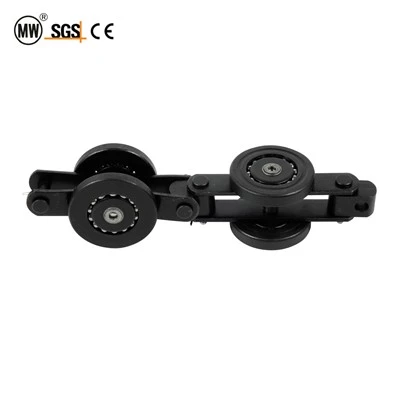
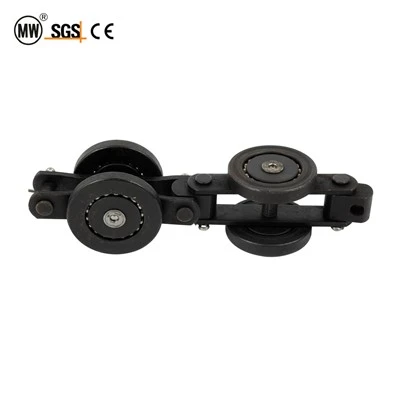
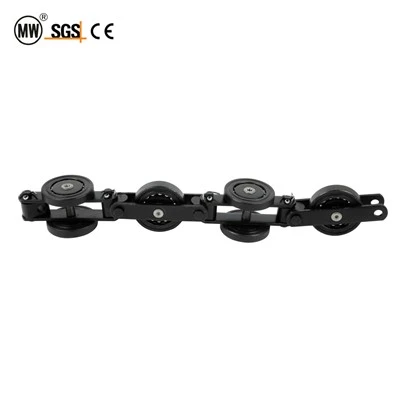
QXG300 Single Guide Overhead Chain With Open Hanger Plate
Hangzhou Ocean Industry Co., Ltd. is one of the most experienced manufacturers and suppliers of qxg300 single guide overhead chain with open hanger plate in China. Welcome to wholesale customized qxg300 single guide overhead chain with open hanger plate at competitive price from our factory. Good service and quality products are available.
Engineered for coating, assembly, and material handling operations requiring maximum durability and extended reach.
Hangzhou Ocean Industry focuses on manufacturing premium QXG300 300mm-Pitch Single Guide Overhead Chain with Open Hanger Plate. Drawing on mature local processing technology and exquisite production techniques, our chains excel in load-bearing performance, wear resistance and stable conveying performance across the industry.
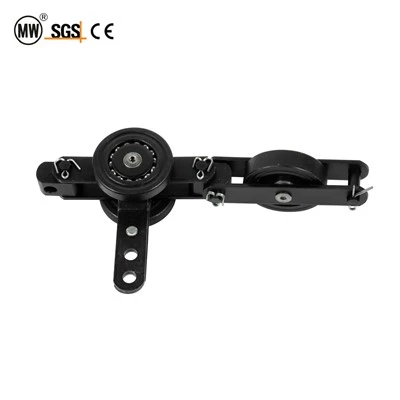
Not every overhead conveying operation benefits from permanently fixed suspension brackets. Production lines that alternate between fixture types-switching from hook-based part carriers to rod-mounted brackets, or adjusting hanger spacing between product batches-need a chain architecture that accommodates change without tooling modifications. The QXG300 open hanger plate overhead chain answers this requirement. Its split-style hanger bracket slots onto each chain link via a quick-connect interface and detaches in seconds, giving conveyor operators the freedom to reconfigure suspension geometry as production schedules evolve.
At 300mm pitch, the QXG300 painting line chain provides the widest standard interval in the QXG single guide series. This expanded spacing proves indispensable when conveying oversized industrial workpieces-truck body panels, large HVAC condenser units, structural steel beams-that cannot physically fit within the 200mm or 250mm pitch envelope. The open hanger plate chain design pairs this generous link interval with a detachable suspension bracket, so engineers can swap hanger hardware mid-run without stopping the conveyor loop, a flexibility that fixed hanger plate chains simply cannot provide.
Hangzhou Ocean Industry Co., Ltd. manufactures the QXG300 across three load-capacity tiers-Standard, Heavy-Duty, and Extra Heavy-each retaining the open hanger interface. Whether your painting line chain conveys lightweight aluminum extrusions at 100 kg per point or heavy industrial conveyor system chain loads approaching 150 kg, the detachable bracket geometry remains identical, allowing hanger hardware to transfer between tiers without redesign.
Open Hanger Plate vs. Fixed Hanger Plate: Why the Distinction Matters
The hanger plate is the component that bridges the chain link body and the suspended workpiece fixture. Two fundamental architectures exist across the QXG series, and choosing the correct one determines whether your conveyor operation runs with maximum flexibility or maximum structural integrity:
|
Open (Split) Hanger Plate - QXG300 |
Fixed (Forged) Hanger Plate - QXG250 |
|
Detachable bracket slides onto link body via slot interface |
Hanger plate forged as integral extension of link plate |
|
Swap fixture types mid-production without chain replacement |
Fixture type fixed per link; changing requires new chain order |
|
Adjust hanger spacing by relocating brackets to different links |
Hanger spacing locked at pitch interval; no mid-run adjustment |
|
Bracket removal enables compact chain storage and shipping |
Fixed geometry increases shipping volume and storage footprint |
|
Slightly lower peak load rating due to interface joint |
Highest per-point load rating-no fastener joint in load path |
|
Best for multi-product lines with frequent fixture changes |
Best for single-product high-volume lines with constant fixtures |
In practice, many conveyor installations benefit from mixing both architectures: fixed hanger plates on high-volume oven zones where fixture geometry never changes, and open hanger plate chain segments on multi-product staging areas where operators switch between hook, rod, and Y-type fixtures daily. The QXG300 and QXG250 share compatible I-beam track profiles and drive engagement geometry, enabling this mixed-architecture approach within a single loop.
Engineering Selection & Configuration Guidance
Specifying the QXG300 for your overhead conveyor project involves four decisions: load tier, hanger bracket type, surface treatment, and track curve geometry. The framework below maps each choice to operational conditions:
Load Tier Decision: QXG300-S (Standard) suits loads under 100 kg per point in ambient-to-200°C environments. QXG300-HD (Heavy-Duty) extends capacity to 125 kg with 240°C thermal tolerance and zinc-plated corrosion defense. QXG300-HA (Extra Heavy) reaches 150 kg at 280°C with hot-dip galvanized finish and tapered roller bearings for combined radial-axial loading.
Hanger Bracket Selection: The open hanger plate interface accepts three bracket geometries-hook type (standard J-hook for direct part suspension), rod type (vertical rod with cross-pin for fixture frames), and Y-type (dual-arm spread for wide-base items). All three slide into the same slot interface and lock with a spring clip. No tools required for bracket changeover; average swap time per link is 8 seconds.
Surface Treatment Matching: Match corrosion defense to your facility's exposure severity. Dry indoor paint shops require only epoxy e-coating (200+ hours salt spray per ISO 9227). Electroplating workshops with acidic bath vapors need zinc plating. Outdoor storage yards or wash-down-intensive food processing lines demand hot-dip galvanizing (500+ hours endurance). Applying a higher-tier treatment than necessary adds cost without proportional benefit; under-specifying leads to premature surface degradation.
Curve Geometry Constraint: The 300mm pitch and larger wheel diameters require wider horizontal turn radii than the 250mm or 200mm series. Minimum horizontal curve: R900 (S variant), R1000 (HD), R1100 (HA). When retrofitting an existing track designed for QXG200 (R600 curves) or QXG250 (R750 curves), track curve modifications are mandatory. Verify all curve radii against the selected variant before placing an order.
Multi-Product Line Configuration Tip: On lines that process three or more product types per shift, deploy open hanger brackets on QXG300 links at loading/unloading stations and switch bracket geometry at batch transitions. Keep a bracket inventory of 20% more than the maximum per-shift requirement. The quick-connect interface reduces batch changeover downtime from 45 minutes (welded bracket reconfiguration) to under 5 minutes.
Operating Environment Specifications
Temperature Envelope: Standard variant rated from –20°C to 200°C (ambient workshop through standard curing oven). Heavy-Duty extends upper boundary to 240°C for prolonged bake cycles. Extra Heavy pushes to 280°C with high-temperature grease and tapered roller bearings. Cold-chain processing at sub-zero temperatures requires a low-temperature grease formulation-specify this at order placement.
Load Parameters: Per-point suspension spans 100–150 kg across the three tiers. Allowable tensile force: 10–15 kN; breaking strength: 100–150 kN. These ratings assume steady-state conveying at speeds between 0.26 and 15.9 m/min. Instantaneous shock loads from fixture impact during automated loading must not exceed 1.5× the rated per-point value.
Speed Operating Band: Recommended continuous operating speed: 2–12 m/min for painted goods conveying. The QXG300 achieves a 1:10 speed ratio, meaning the drive motor can regulate travel speed across a ten-fold range without losing smooth traction. At speeds above 12 m/min, verify that the open hanger bracket clip retains secure engagement-centrifugal force on suspended items increases bracket stress at higher velocities.
Chemical Exposure Guidance: Avoid direct immersion of open hanger brackets in corrosive bath solutions. The bracket slot interface tolerates vapor exposure but not liquid submersion. On lines where items dip into plating tanks, specify fixed hanger plate links (QXG250 or QXG300 fixed variant) at immersion zones and transition to open hanger plate chain segments at drying and loading stations.
Technical Specification Table
|
Parameter |
QXG300-S |
QXG300-HD |
QXG300-HA |
|
Chain Pitch |
300 mm |
300 mm |
300 mm |
|
Chain Weight per Meter |
10.0 kg |
12.5 kg |
14.5 kg |
|
Allowable Tensile Force |
10 kN |
13 kN |
15 kN |
|
Breaking Tensile Force |
100 kN |
120 kN |
150 kN |
|
Single-Point Load Rating |
100 kg |
125 kg |
150 kg |
|
Hanger Interval Formula |
300+(300×N) |
300+(300×N) |
300+(300×N) |
|
Horizontal (Walking) Wheel Dia. |
83 mm |
90 mm |
100 mm |
|
Vertical (Guide) Wheel Dia. |
85 mm |
92 mm |
105 mm |
|
Bearing Configuration |
Sealed Ball 6206 |
Sealed Ball 6306 |
Tapered Roller 30206 |
|
Min. Horizontal Turn Radius |
R900 |
R1000 |
R1100 |
|
Min. Vertical Bend Radius |
R3500 |
R4000 |
R4500 |
|
Peak Operating Temperature |
200°C |
240°C |
280°C |
|
Corrosion Protection |
Epoxy E-Coating |
E-Coating + Zinc Plate |
Hot-Dip Galvanized |
|
Hanger Plate Design |
Open - Detachable Split |
Open - Detachable Split |
Open - Reinforced Split |
|
Link Plate Thickness |
6 mm (16Mn) |
7 mm (16Mn) |
8 mm (16Mn) |
|
Pin Diameter |
11.5 mm (30# steel) |
13 mm (30# steel) |
14 mm (30# steel) |
|
Track Section |
100×100×36×5 |
100×100×36×5 |
100×100×36×5 |
|
Speed Range |
0.26–15.9 m/min |
0.26–15.9 m/min |
0.26–15.9 m/min |
Specification Interpretation Notes:
• Hanger Interval: N represents empty links between loaded hangers. At 300mm pitch with N=1, effective spacing is 600mm. With N=2, spacing reaches 900mm-suitable for large fixtures that need generous inter-item clearance on curved track sections.
• Open Hanger Bracket Interface: The split hanger plate features a machined slot on the link plate body. Brackets slide into this slot vertically and secure with a spring steel retaining clip. The clip can be removed and reinserted by hand-no wrenches, no fasteners. This design has been validated for 1.5 million articulation cycles with bracket retention integrity maintained.
• Track Section Compatibility: All three QXG300 tiers run on the same 100×100×36×5 square tube track. This track profile differs from the QXG250's 80×80×4 profile-retrofitting from QXG250 to QXG300 requires track replacement. However, I-beam installations using standard 4-inch flange accommodate both series with appropriate guide wheel sizing.
• All values measured per ISO 18334 at 20°C / 60% RH. Custom pitch, hanger geometry, and bearing configurations available upon request.
Conveyor System Operation Principle
A QXG300-based overhead conveyor forms a closed continuous circuit on square-tube track (100×100×36×5 profile) or I-beam rail. The chain performs two simultaneous functions: transmitting traction force from the drive station and carrying suspended workpieces via the open hanger brackets. A caterpillar drive or sprocket mechanism at the drive station engages the chain's link plates, pulling the entire loop forward at a regulated speed within the 0.26–15.9 m/min range.
Walking wheels (horizontal orientation, 83–100 mm diameter per variant) roll along the track's bottom surface, converting the drive's pulling force into steady linear travel. Guide wheels (vertical orientation, 85–105 mm) engage the track web during elevation changes, preventing lateral displacement on slopes and at curve entry/exit transitions. The single guide wheel configuration simplifies track requirements to a single rail profile-no dual-beam infrastructure needed.
At the loop's return end, a take-up idler redirects the chain back toward the drive station. A gravity or spring-loaded tensioning device near the drive compensates for thermal expansion through oven zones and gradual elongation from service wear. The open hanger brackets maintain consistent downward orientation throughout horizontal curves and vertical transitions, ensuring fixture positioning predictability at automated loading stations.
Bracket changeover happens at designated loading/unloading stations where the chain slows to crawl speed or pauses briefly. Operators slide out the current bracket type, insert the required type, and secure the spring clip-all without removing the chain from the track or halting the overall loop motion on other sections. This localized swap capability is the operational advantage that distinguishes the open hanger plate chain from fixed-plate alternatives.
FAQ

You Might Also Like

Send Inquiry