


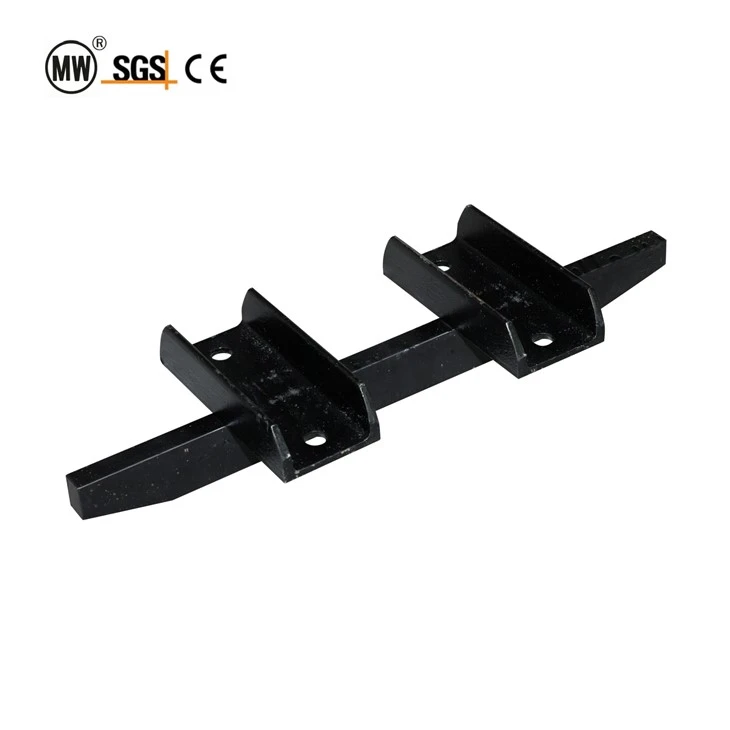
Double Hanger Bracket For Overhead Paint Conveyor Chain
Hangzhou Ocean Industry Co., Ltd. is one of the most experienced manufacturers and suppliers of double hanger bracket for overhead paint conveyor chain in China. Welcome to wholesale customized double hanger bracket for overhead paint conveyor chain at competitive price from our factory. Good service and quality products are available.
Double Hanger Bracket for Overhead Paint Conveyor Chain
In high-volume paint and powder coating lines, throughput is dictated by three variables: chain speed, hanger pitch (the centre-to-centre distance between consecutive hangers on the chain), and the number of workpieces carried per hanger position. Chain speed is constrained by spray-booth dwell times and oven cure cycles. Hanger pitch is constrained by the chain's link-plate spacing and the size of the workpieces. But the third variable - workpieces per hanger position - has headroom: switching from a single hanger to a double hanger bracket instantly doubles the number of parts processed per chain revolution without increasing chain speed, extending track length, or adding additional chain links. This is the productivity lever that the double hanger bracket provides.
The double hanger bracket (also called a dual-point hanging bracket, Y-type twin hanger, double drop rod carrier, or two-position workpiece suspension frame) is a forged or fabricated steel component that bolts directly to the conveyor chain's link plates and provides two independent attachment points for workpiece hooks, cross bars, or custom fixture jigs. The bracket's two hanging positions are separated by a minimum centre distance - typically 150–300 mm depending on the chain series - that prevents adjacent workpieces from contacting, rotating, or interfering with each other as the chain negotiates horizontal and vertical curves. The two positions are symmetrical about the chain centreline to maintain balanced loading and prevent asymmetrical wear on the guide wheels and track.
For paint and coating lines specifically, the double hanger bracket must satisfy a set of demands that go beyond simple structural load carrying. It must maintain reliable electrical grounding continuity from the chain through the bracket to both workpieces - an ungrounded workpiece will not attract charged powder in an electrostatic spray booth, resulting in an uncoated reject. The bracket's geometry must minimise the "shadow effect" where the bracket itself blocks spray from reaching the workpiece surface directly behind it. Joints and threaded connections must resist oven temperatures of up to 250 °C without loosening from thermal cycling. And the bracket must be designed for rapid workpiece changeover - operators loading and unloading on a continuously moving line need a bracket that accepts and releases workpieces quickly without tools, jams, or pinch hazards.
Double Hanger Configurations
Double hanger brackets are available in several geometric configurations, each optimised for specific workpiece profiles and coating-line layouts. The following configurations are standard across all QXG chain series:
|
Configuration |
Description & Best Applications |
|
Y-Type Double Hanger |
Two drop rods or hook points extend downward and outward from a central mounting boss at angles of 15–45° from vertical. The Y geometry separates the two workpieces laterally, creating clearance for rotation and ensuring both faces of each workpiece receive direct spray coverage. Best for: small to medium stamped metal parts, brackets, housings, and components up to 15 kg per point on QXG200/206 systems. |
|
Parallel Twin Hanger |
Two vertical drop rods extend straight down from the chain level, parallel to each other and spaced at the centre distance determined by the chain's link-plate width. This configuration provides maximum workpiece separation in the plane perpendicular to chain travel. Best for: long parts hung vertically (exhaust pipes, trim strips, tubing), where the vertical hanging orientation is required for even coating thickness. |
|
Cross-Bar Type Hanger |
A horizontal cross bar extends outward from the chain link on one side, with two or more hanging points distributed along the bar. The cross bar offsets the workpieces to one side of the chain, useful when only one side of the chain is accessible for loading/unloading or when the booth's spray envelope is asymmetric. Best for: asymmetric loading stations where operators load from one side only, or booths with wall-mounted reciprocators targeting one chain side. |
|
Cross Disc Type with Integrated Oil Shield |
A cross bar with a circular disc stamped on the top surface, directly above the two hanging points. The disc catches any oil dripping from the chain's guide wheels or link plates before it reaches the workpieces below - an integrated contamination guard that eliminates the need for a separate oil catch plate at the hanger position. Best for: high-value finishing operations (automotive clear-coat, Class-A surfaces) where even a single oil speck is a reject defect. |
Design & Construction
The double hanger bracket is manufactured from alloy steel using a combination of hot-forging, CNC machining, and surface treatment processes. Its construction reflects the simultaneous demands of structural load bearing, electrical conductivity, thermal stability, and spray-access geometry:
Material & Manufacturing Process
|
Construction Feature |
Specification |
|
Base Material |
45# medium-carbon steel (C 0.42–0.50%); selected for balance of strength, fatigue resistance, and forgeability |
|
Manufacturing Process |
Hot-forged from bar stock to near-net shape; critical attachment eyes and mounting faces finish-machined by CNC for dimensional accuracy |
|
Heat Treatment |
Carburised and quenched to 0.8–1.2 mm case depth; surface hardness 58–62 HRC; core hardness 30–40 HRC for ductility under impact loading |
|
Surface Finish (Standard) |
Black oxide coating with anti-rust oil; provides moderate corrosion resistance suitable for indoor painting lines |
|
Surface Finish (Optional) |
Electroless nickel plating (ENP) - uniform nickel-phosphorus coating with 400+ hours salt-spray resistance; recommended for e-coat lines and humid environments |
|
Surface Finish (Optional) |
Zinc plating with yellow chromate passivation - bright finish for visible-quality requirements; 200+ hours salt-spray resistance |
|
Mounting Boss Geometry |
Machined flat face with two M10 or M12 through-holes matching the chain link-plate bolt pattern; boss thickness 8–12 mm depending on chain series |
|
Drop Rods / Hanging Arms |
Forged integral with mounting boss (one-piece construction) for maximum fatigue strength at the boss-to-arm transition; arm diameter 12–16 mm |
|
Workpiece Attachment Ends |
Threaded M10–M12 stud (for nut-secured hook attachment), or Ø15–20 mm plain eye (for hook-and-pin attachment); chamfered entry for rapid operator loading |
Electrical Grounding Design
In electrostatic powder coating and liquid painting, reliable grounding of the workpiece is essential for transfer efficiency and coating uniformity. The double hanger bracket is designed with an uninterrupted conductive path from the chain link plate (which is grounded through the guide wheels, track, and conveyor support structure) through the bracket's forged body to both workpiece attachment points. Critical design elements include: (1) bare-metal contact faces at the chain-mounting boss with no paint, oxide, or coating between the boss and the chain link plate; (2) one-piece forged construction - no welded joints that would introduce resistance or fatigue-fracture points; (3) masking of the workpiece attachment ends during surface treatment plating or oxide coating to preserve bare-metal conductivity at the hook contact point. For lines processing non-conductive substrates (plastics, composites), the bracket also provides a grounding path for the conductive primer that bridges the workpiece surface to the earthed conveyor system.
Spacer Pitch Options
The centre-to-centre spacing between consecutive hanger positions on the chain - the hanger pitch - is adjustable through the selection of alternating link plates. Standard spacer pitches are 300 mm, 600 mm, and 900 mm, achieved by mounting the double hanger bracket on every second, fourth, or sixth chain link respectively. The optimal pitch is determined by the workpiece envelope dimensions plus a minimum clearance of 50–100 mm between workpieces to prevent collision on curves. A double hanger at 300 mm pitch provides the maximum throughput density; a double hanger at 900 mm pitch provides maximum clearance for large or rotating workpieces. The double hanger bracket itself does not affect the pitch - it simply doubles the number of workpieces at whatever pitch the chain is configured for.
Technical Specifications
The double hanger bracket is available in chain-series-specific configurations. The following table covers the standard product range across all compatible QXG chain models:
|
Parameter |
QXG150/200/206 Series |
QXG240/250/300 Series |
|
Compatible Chain Series |
QXG150, QXG200, QXG206 |
QXG240, QXG250, QXG300 |
|
Max Load per Hanging Point |
8 kg (QXG150); 30 kg (QXG200); 30 kg (QXG206) |
50 kg (QXG240); 50 kg (QXG250); 125 kg (QXG300) |
|
Max Total Bracket Load |
16 kg (QXG150); 60 kg (QXG200/206) |
100 kg (QXG240/250); 250 kg (QXG300) |
|
Material |
45# forged carbon steel |
45# forged carbon steel |
|
Surface Hardness |
58–62 HRC (carburised case, 0.8–1.2 mm depth) |
58–62 HRC (carburised case, 0.8–1.2 mm depth) |
|
Core Hardness |
30–40 HRC |
30–40 HRC |
|
Mounting Boss Thickness |
8 mm |
10–12 mm |
|
Mounting Bolt Size |
M10 × 35 mm (2 bolts per bracket) |
M12 × 40 mm (2 bolts per bracket) |
|
Bolt Grade |
Grade 8.8 (standard); Grade 10.9 (optional for high-vibration) |
Grade 10.9 (standard) |
|
Drop Rod / Arm Diameter |
12 mm (Y-type / parallel) |
14–16 mm (Y-type / parallel / cross-bar) |
|
Hang Point Centre Distance |
150–180 mm |
200–300 mm |
|
Hang Point Drop Length (below chain) |
100–300 mm (standard); custom lengths available |
150–400 mm (standard); custom lengths available |
|
Workpiece Attachment Type |
M10 threaded stud or Ø15 mm plain eye |
M12 threaded stud or Ø20 mm plain eye |
|
Bracket Weight per Unit |
~0.4–0.8 kg (depending on drop length) |
~0.8–1.5 kg (depending on drop length) |
|
Operating Temperature |
–20 °C to +250 °C (black oxide); –20 °C to +300 °C (ENP) |
–20 °C to +250 °C (black oxide); –20 °C to +300 °C (ENP) |
|
Electrical Conductivity |
Full continuity from mounting face to both hanging points; <0.1 Ω resistance under 100 g contact load |
Same |
|
Standard Spacer Pitches |
300, 600, 900 mm (selectable by link spacing) |
300, 600, 900 mm (selectable by link spacing) |
|
Corrosion Resistance (Black Oxide) |
Indoor use only; apply anti-rust maintenance oil monthly |
Indoor use only; apply anti-rust maintenance oil monthly |
|
Corrosion Resistance (ENP) |
400+ hours neutral salt-spray (ASTM B117); outdoor-rated |
400+ hours neutral salt-spray; outdoor-rated |
Single vs. Double Hanger Bracket: Throughput Economics
The decision between single and double hanger brackets is fundamentally an economic one: the double hanger doubles per-chain-position throughput for an incremental hardware cost of approximately 30–50% over a single hanger. The following comparison quantifies the throughput uplift:
|
Comparison Factor |
Single Hanger Bracket vs. Double Hanger Bracket |
|
Parts per chain position |
1 workpiece (single hanger) → 2 workpieces (double hanger) = 100% throughput increase |
|
Hardware cost per position |
Single bracket ~USD 3–8 (depending on series and finish) → Double bracket ~USD 5–12 = ~50% cost increase |
|
Capital cost per additional part/hour |
Adding a second chain loop: USD 3,000–10,000 in track, chain, drive hardware → Adding double hangers: USD 300–1,000 in bracket hardware (97% capital savings vs. second line) |
|
Ongoing energy cost |
Single chain loop with double hangers = same motor power, same oven fuel, same booth airflow as single hangers. Two parallel lines = 2× energy cost |
|
Footprint impact |
No additional floor space - same track length, same booth size, same oven capacity. Second line = 2× floor space requirement |
|
Changeover time |
Double hanger requires both hanging points loaded per cycle, doubling operator workload at the load station. Mitigation: position load station before a slow-curve section where operators have 3–5 seconds per part |
|
Curve clearance constraint |
Double hanger workpieces on the inner radius of a curve can collide if the centre distance is too small. Verify minimum clearance at the tightest curve radius before specifying double hangers |
For lines processing small to medium parts (under 30 kg per piece on QXG200/206, under 50 kg on QXG250), the double hanger is almost always the correct economic choice. The only scenario where single hangers are preferred is when workpieces are too large to hang two per position without collision on curves, or when the operator load station cannot sustain the doubled loading rate.
FAQ

Hot Tags: double hanger bracket for overhead paint conveyor chain, China double hanger bracket for overhead paint conveyor chain manufacturers, suppliers, factory
Previous
No InformationYou Might Also Like



Send Inquiry