


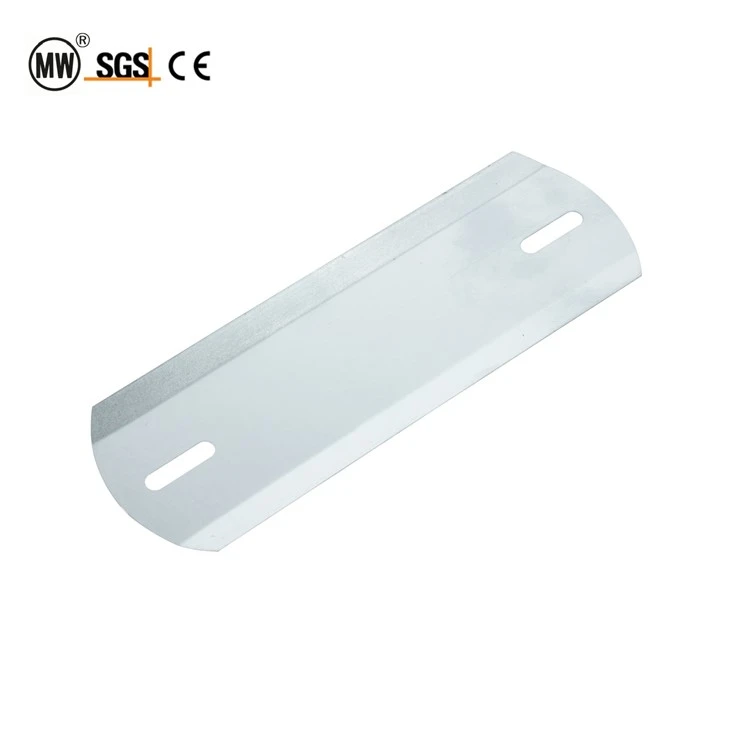
Single Rounded End Oil Catch Plate For Transition Conveyor Track
Hangzhou Ocean Industry Co., Ltd. is one of the most experienced manufacturers and suppliers of single rounded end oil catch plate for transition conveyor track in China. Welcome to wholesale customized single rounded end oil catch plate for transition conveyor track at competitive price from our factory. Good service and quality products are available.
Single Rounded End Oil Catch Plate for Transition Conveyor Track
Every enclosed-track overhead conveyor circuit contains transition zones - the critical junctions where a straight track segment meets a horizontal curve, vertical bend, or compound directional change. At these junctions, the chain experiences a shift in running dynamics: guide wheels pivot, link plates articulate, and lubricant that was evenly distributed along the straight section suddenly migrates outward under centrifugal force as the chain enters the curve. This transition is where oil-drip contamination incidents are most concentrated, and it is the exact location that the single rounded end oil catch plate is engineered to protect.
The single rounded end oil catch plate (also called a transition-track curved drip tray, bend-junction oil guard, or directional-change oil collector) is a purpose-formed galvanized steel or stainless steel tray with one end shaped to follow the tangent-to-arc geometry of a track transition. Unlike a straight end plate, which terminates with a flat 90-degree edge suited for butt-joining against another straight section, the rounded end plate curves smoothly to match the onset of the bend rail, closing the gap that would otherwise exist between a straight catch plate's rectangular terminus and the curved track's arc. This curved geometry is what gives the plate its name - a single rounded end that seamlessly transitions oil containment from the linear track into the curve without an unprotected drip zone.
The plate's engineering rationale is rooted in fluid dynamics at track transitions. When chain lubricant is shed from the link plates during straight-line running, droplets fall vertically under gravity. But as the chain enters a horizontal curve, centrifugal acceleration flings droplets outward at an angle that can be 15–30 degrees from vertical, depending on chain speed and curve radius. A straight end catch plate terminated at the tangent point of the curve leaves a triangular unprotected zone - the area between the plate's flat end and the start of the bend section's curved catch plate - where these angle-deflected droplets escape uncollected. The single rounded end plate eliminates this vulnerability by extending oil capture into the transition arc itself, intercepting angle-deflected droplets before they disperse beyond the plate's containment envelope.
Why Transition Zones Are the Weakest Link in Oil Containment
Most oil-drip contamination on overhead conveyor finishing lines does not occur at random along the track. It clusters at transition points - and understanding why reveals the critical role of the rounded end catch plate:
Centrifugal deflection at curve entry. When the chain transitions from a straight section to a horizontal curve, guide wheels must rotate to follow the arc. This rotation pumps additional lubricant out of the wheel bearings and pin interfaces at precisely the moment when centrifugal force begins pushing droplets outward rather than straight down. The result is a burst of oil release that is both larger in volume and wider in spread angle than anything seen on the straight section.
Chain whip at direction-change joints. At the tangent point where straight track meets curve, the chain experiences a sudden change in lateral constraint. The link plates briefly oscillate laterally (chain whip) before settling into the curve's guidance. This whip action shakes lubricant loose from pin-bushing clearances that were stable during straight running, releasing droplets that a straight-ended plate terminated at the tangent point cannot capture.
Geometric gap between straight and bend plates. When a straight end catch plate and a bend section catch plate are installed at a transition, their respective end profiles do not match: the straight plate has a flat end, the bend plate has a curved end. The resulting mismatch creates a triangular open gap through which oil can fall. The single rounded end plate bridges this gap by matching the bend plate's curvature on one end while maintaining the straight plate's linear profile on the other.
Vertical bend transition dynamics. At vertical curve transitions (dips and rises), the chain changes incline angle. Lubricant that was sitting in the horizontal pin-bushing clearance flows toward the lower end of each pin as the chain tilts, and this redistribution causes a surge of drip release at the inflection point. The rounded end plate's extended capture envelope covers this inflection zone that a straight-ended plate would leave exposed.
Field audits of powder-coating lines consistently show that 60–75% of oil-contamination rejects originate from workpieces that passed beneath transition zones - not from the long straight runs between curves, which are typically well-protected by straight end plates. The single rounded end catch plate directly addresses this statistical concentration by deploying targeted containment exactly where the problem is most severe.
Design & Construction
The single rounded end oil catch plate is manufactured using a combination of press-brake forming and custom die-stamping to produce the characteristic curved terminus. Its construction reflects the demands of transition-zone deployment:
Material & Surface Protection
|
Construction Feature |
Specification |
|
Base Material (Standard) |
Q235 cold-rolled steel, 1.0–1.5 mm thickness; press-brake formed for straight body, die-stamped for rounded end |
|
Base Material (Optional) |
304 stainless steel, 1.0–1.2 mm; specified for electroplating lines, food-grade conveyors, and corrosive-environment installations |
|
Surface Treatment (Standard) |
Hot-dip galvanizing to ISO 1461 (minimum 55 µm zinc coating); 500+ hours neutral salt-spray resistance |
|
Surface Treatment (Optional) |
Epoxy electrophoretic coating (e-coating), black; for indoor painting lines where galvanized surface appearance is not preferred |
|
Rounded End Radius |
Matched to the specific QXG bend track radius (typically R500, R600, R800, R1000, R1200 mm depending on chain series) |
|
Edge / Corner Finish |
Deburred and radiused edges on all surfaces; the rounded end transitions smoothly with no step or lip that could trap debris |
|
Drainage Feature |
Optional 15–20 mm drain port at the straight end (low point when installed on slightly inclined transition); threaded brass plug with PTFE tape |
Rounded End Geometry
The defining feature of this catch plate is the curved terminus on one end. The radius of the rounded end is not arbitrary - it is matched to the specific bend track radius used in the conveyor circuit. A QXG200 system with R600 horizontal curves requires a rounded end plate with R600 curvature; using a plate with a mismatched radius creates a gap between the plate's curve and the track's curve, defeating the purpose of the rounded end. The plate's straight body extends backward from the rounded terminus for 1 000–2 000 mm, providing linear coverage of the approach zone leading into the curve.
Mounting System
The plate mounts to the underside of track support brackets using pre-punched slotted holes along the straight body section. The rounded end section is secured via a dedicated mounting tab that extends from the underside of the curved portion, bolted to the bend-track support bracket at the tangent point. This dual-zone mounting (straight-body brackets + curve-tangent bracket) ensures the plate maintains its position and alignment even as thermal expansion shifts the straight body relative to the fixed curve. M8 or M10 bolts with flat washers and nylon-insert lock nuts are used throughout; no welding is required.
Technical Specifications
The single rounded end oil catch plate is offered in configurations matched to each QXG chain series and bend-track radius combination. The following table covers the standard product range:
|
Parameter |
QXG150/200/206 Series |
QXG240/250/300 Series |
|
Compatible Chain Series |
QXG150, QXG200, QXG206 |
QXG240, QXG250, QXG300 |
|
Compatible Track Profile |
72 × 68 × 4 mm enclosed I-beam |
80 × 80 × 4 mm (or 5 mm) enclosed square rail |
|
Plate Profile |
U-channel (open top) with single rounded end |
U-channel (open top) with single rounded end |
|
Plate Width (overall) |
160–180 mm |
180–200 mm |
|
Side Wall Height |
25–30 mm |
30–40 mm |
|
Material Thickness |
1.0–1.2 mm (steel); 1.0 mm (SS304) |
1.2–1.5 mm (steel); 1.2 mm (SS304) |
|
Straight Body Length |
1 000 mm or 2 000 mm (selectable) |
1 000 mm or 2 000 mm (selectable) |
|
Rounded End Radius (standard) |
R500, R600, R800 mm (match to bend track) |
R600, R800, R1000, R1200 mm (match to bend track) |
|
Rounded End Arc Coverage |
90° (covers from tangent point to 90° into the curve) |
90° (covers from tangent point to 90° into the curve) |
|
Mounting Holes (straight body) |
9 mm slots at 500 mm intervals (for M8 bolt) |
11 mm slots at 500 mm intervals (for M10 bolt) |
|
Mounting Tab (rounded end) |
1 × M8 or M10 bolt-hole tab at tangent point |
1 × M8 or M10 bolt-hole tab at tangent point |
|
Vertical Clearance Below Track |
60–70 mm (track underside to plate floor) |
70–80 mm (track underside to plate floor) |
|
Drain Port (optional) |
1/2″ BSP threaded port with brass plug (at straight end) |
1/2″ BSP threaded port with brass plug (at straight end) |
|
Maximum Oil Containment Volume |
~1.5 L (1 m body) to ~3.0 L (2 m body) + ~0.5 L curved end |
~2.0 L (1 m body) to ~4.0 L (2 m body) + ~0.8 L curved end |
|
Operating Temperature |
–20 °C to +250 °C (galvanized); –20 °C to +300 °C (SS304) |
–20 °C to +250 °C (galvanized); –20 °C to +300 °C (SS304) |
|
Chemical Resistance |
Mineral oils, synthetic lubricants, mild alkaline cleaners; SS304 for acid-vapour resistance |
Same |
|
Weight per Unit (steel, 2 m body) |
~4.0 kg (1.2 mm) to ~5.0 kg (1.5 mm) |
~4.5 kg (1.2 mm) to ~6.0 kg (1.5 mm) |
|
Weight per Unit (SS304, 2 m body) |
~3.5 kg (1.0 mm) |
~4.2 kg (1.2 mm) |
|
Installation Method |
Bolt-on to track support brackets + tangent-point tab; no welding |
Bolt-on to track support brackets + tangent-point tab; no welding |
Note: When ordering, specify the chain series, bend-track radius, and straight body length. The rounded end radius must match the bend track radius exactly - a mismatch of even 50 mm creates a gap that allows angle-deflected oil droplets to escape. For conveyor circuits with multiple different curve radii, order rounded end plates with the corresponding radius for each transition point.
Single Rounded End vs. Straight End Catch Plates
The rounded end and straight end catch plates are complementary products - each serves a specific role in a complete oil-containment system. Understanding their division of responsibility ensures correct specification:
|
Feature |
Single Rounded End Catch Plate |
|
Primary deployment location |
Transition zones where straight track meets horizontal or vertical curve; tangent-point junctions |
|
End geometry |
One rounded end (curve-matched radius) + one straight end (for joining to straight body or straight end plate) |
|
Oil capture angle range |
0° (vertical drip) to 30° (centrifugally deflected drip at curve entry) |
|
Installation complexity |
Moderate - requires radius matching to bend track; tangent-point tab alignment; ~25–35 minutes per unit with two personnel |
|
Oil flow direction |
Drains from curved end toward straight end (or toward drain port at straight end); curved end is the high point when track is level |
|
Coverage role in system |
Seals the transition gap between straight end plates and bend section plates; covers the tangent-point vulnerability zone |
|
Typical quantity per conveyor circuit |
Equal to the number of horizontal and vertical curve transition points (typically 8–20 per line) |
In a complete conveyor-line oil-containment system, straight end plates cover the long linear runs, single rounded end plates seal each transition zone, and bend section plates (full-curve trays) cover the body of each curve. The rounded end plate is the bridge component that makes the system continuous - without it, every transition point becomes an unprotected drip gap.
Key Design Features
Radius-matched curved terminus. The rounded end is die-stamped to match the exact bend track radius (R500–R1200 mm depending on chain series). This geometric match ensures the plate's curved section follows the track's arc with minimal gap, preventing the triangular drip zone that forms when a straight-ended plate terminates at a curve tangent point.
Centrifugal-force-aware capture volume. The curved end section has 15–20% greater internal volume per unit length than the straight body, accounting for the higher oil volume shed at curve entry due to centrifugal deflection and chain-whip release. This volume differential prevents overflow at the transition zone during high-speed operation.
Dual-zone mounting for transition stability. The straight body uses slotted mounting holes for lateral adjustment, while the curved end uses a dedicated tangent-point tab for positive positioning against the bend track bracket. This dual-zone approach accommodates thermal expansion of the straight body without shifting the critical curved-end alignment.
Bolt-on installation - no hot-work permits required. The entire plate is secured with standard bolts and lock nuts. No welding is needed, which means installation can proceed in operating finishing lines without hot-work permit delays, fire-watch requirements, or risk of weld spatter damaging adjacent painted surfaces or track galvanizing.
Dual material options for environment matching. Hot-dip galvanized steel (standard) for indoor painting and powder-coating environments. 304 stainless steel (optional) for electroplating lines with acid-vapour exposure, outdoor installations, and food-grade conveyor applications. The curved end's die-stamping process is compatible with both material grades.
Smooth curve interior for uninterrupted oil flow. The U-channel interior of the curved section is free of internal seams, weld beads, or step transitions that would trap oil residue or create cleaning dead-zones. Oil flows smoothly from the curved end toward the straight end (or drain port) under gravity, even at the transition from curved to straight geometry.
Suitable Operating Environment
The single rounded end oil catch plate is designed for deployment in the same environmental conditions as the QXG enclosed-track conveyor system it serves. The following parameters define its rated performance envelope:
|
Environmental Factor |
Specification |
|
Temperature Range |
–20 °C to +250 °C (galvanized steel); –20 °C to +300 °C (304 stainless steel) |
|
Humidity |
10%–95%, non-condensing; galvanized zinc coating provides corrosion protection in humid finishing-line environments |
|
Oil / Lubricant Compatibility |
Mineral oils, synthetic chain lubricants (PAO, ester-based), semi-fluid greases; verify compatibility if using EP (extreme-pressure) additives |
|
Chemical Exposure |
Resistant to mild alkaline cleaning solutions and neutral-pH rinse water; galvanized steel not recommended for continuous acid-vapour exposure (specify SS304 for electroplating lines) |
|
UV Exposure (outdoor) |
Galvanized coating weathers to a matte grey patina with no structural degradation; SS304 is UV-immune and preferred for prolonged outdoor service |
|
Mechanical Impact Risk |
Designed for static installation beneath track; incidental contact from swinging workpieces at curve entry may dent side walls but will not fracture the plate or compromise the curved-end seal |
|
Mounting Orientation |
Installed beneath transition zone with straight body horizontal and curved end following the bend track; a 1–3° slope on the straight body toward the drain port aids gravity drainage |
|
Chain Speed Range |
Effective at chain speeds from 0.5 m/min to 25 m/min; above 25 m/min, centrifugal deflection angles exceed 30° and a wider custom plate may be required |
FAQ

Hot Tags: single rounded end oil catch plate for transition conveyor track, China single rounded end oil catch plate for transition conveyor track manufacturers, suppliers, factory, Bearing Gear Spreader, Bearing Spreader, Cross Disc Spreader, Flange Plate, Plating Conveyor Spreader, spreader
You Might Also Like



Send Inquiry